'The Loop', the work Wendy McMurdo and I co-authored in 2008, showing at Streetlevel Gallery, Glasgow, as part of 'Generation', the 25 year retrospective of Scottish contemporary art.  28 June - 17 August 2014.


Installation views of my sound work, 'Memory's Journey', showing at Belleisle Park, Ayr, as part of the Burns Festival today and tomorrow the 24th and 25th May 2014.


Still frames from 'Time Machine'.


Installation shots from 'Time Machine'.  The work is showing as part of the group show, at One Cube or Two, 134 Renfrew St, G3, for a week, from Friday 13th December 2013.  The opening is this Friday from 1800-2100.


Test shots for 'Time Machine'.


I was very pleased to hear from Taylor Wilson that she was interested in working as a singing consultant on my untitled Burns-Tagore project. The project is a sound installation involving the human voice. Taylor travels all round the world perfoming principal roles with international opera companies and is an acclaimed experimental artist in her own right.

I also met up with Wendy McMurdo this week. I enjoyed hearing about all her exciting projects. It is five years since we shot our co-authored two screen film 'The Loop' and she continues tirelessly to promote it. The film will be showing at the Night Contact Festival in London on the 27th September. Wendy has plans for the film in 2014; I look forward to working with her on that.

Stills from 'The Loop'. Copyright Wendy McMurdo and Paul Holmes.


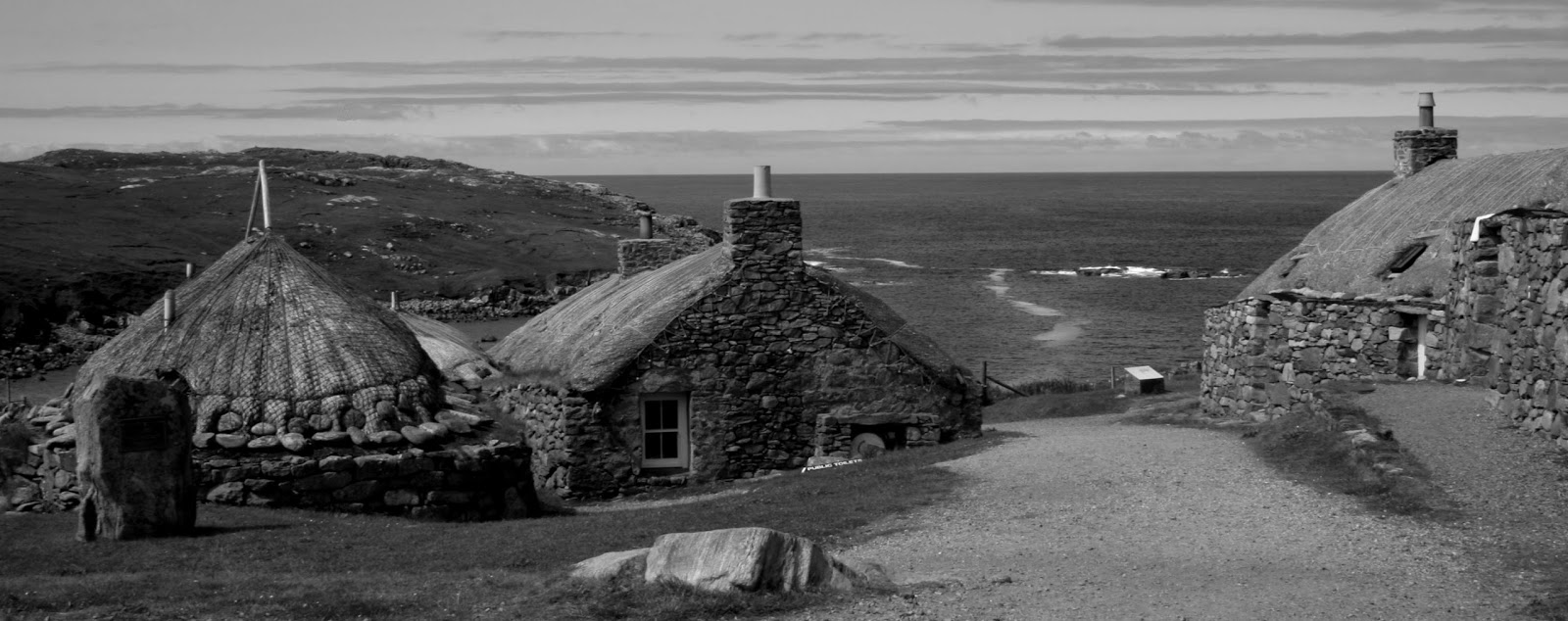
The black house village at Gearrannan, Isle of Lewis.  This place inspired me to write 'The Glass' - the script that later became 'The Persistence of Vision'.


 'The Persistence of Vision': Inputting text from the script - Page 7 of 11.
Haftor and I spoke a good deal about moving image artworks. One thing that fascinates me is the fact that the form is so young that any project feels like an experiment; that the boundaries, the parameters and conventions of the medium have yet to become fully accepted let alone in any way ossified. A film maker needs always to ask themselves what is a suitable subject to be filmed for this kind of exhibition medium, and what is the appropriate treatment.

We talked about Joachim Koester, whose Tarantism (2007), like this jazz project, takes something that is generated by music and strips out the sound to create a visual spectacle whose fresh context endows it with new meaning. And I was reminded too of my conversation with Sally O'Reilly. After we had met I found myself thinking about Marina Abramović and her work Imponderabilia (1977). Haftor knew the work; he had performed a response to the exhibition From Death to Death and Other Small Tales, which is still playing for another week or so at the National Gallery of Modern Art, and which features a couple of pieces of hers.

The crux of Imponderabilia, as Sally O'Reilly explained in her talk the other day, is the reactions of the people coming into the gallery space: do they turn to face Abramović or Ulay? And do they make eye contact as they inevitably brush up against these naked, deadpan bodies? After my chat with O'Reilly about distanciation I pondered whether the work was more powerful as video footage or if the viewer saw the performance at the time it was staged. Self consciousness would meant most spectators at the original performance would have been hard pressed to watch it for long. But a camera is impersonal and soon forgotten. Its unrelenting eye enables us to study the performance as long as we wish without embarrassment. The camera transforms us into voyeurs and seems to me to complete the work, not to weaken it.
In July I went to see my colleague Haftor Medbøe perform at the Jazz Festival. Haftor put a band together with jazz talent from across Scandinavia and the result, after only one day's rehearsal, was astonishing. I was transfixed by the faces of the musicians as they worked. Their expressions, of struggle, and reasoning, of agony, passion, and puzzlement, seemed both to complement and contrast with the music they were playing. I thought it would make an extraordinary subject for a film. Today Haftor and I met to discuss the idea for the first time and I was delighted with his enthusiastic response. I was relieved that it was so easy to convince him it would be worthwhile. Next comes the hard part: raising the finance to make it.
Last Monday I went to see Sally O'Reilly speak at the National Gallery of Modern Art. I enjoyed her book, The Body in Contemporary Art, and was fortunate to get the chance to chat briefly to her afterwards about performance, art and film making. My feeling is that, in video art, as in cinema, performance and film are inseparable - that time based artworks are at their most powerful when they complement, manipulate and enhance a performance, rather than simply being a documentation. I'm not sure she entirely agreed with me. I think she may side with the performance purists who believe the distanciation of video weakens the impact of a performance. Still, it was good to speak to her nevertheless.

The theme that has remained with me from her talk more than any other was her brief digression on clichés. She spoke of them, in Derrida's terms as 'worn coins', as something unavoidable, as central to the constant exchange that is language. I have become conscious recently of the extreme frequency with which people use them in conversations, in newspapers, academic papers, books, and, of course, on the radio and TV. I resolved to speak, write, communicate without their aid. And found myself seized by a kind of paralysis - unable to speak, inept in emails and unwilling to post in social media: My inner censor struck out so many phrases I was left with nothing left to say...
'These Measures are for Your Protection': original scanned images prior to the edit.  Not all these shots were suitable; a number had to be discarded in the cut.


This week, I was visited by a cousin from Pittsburgh, who brought me a copy of Klaus Honnef's little book on Warhol.  This came with a very tempting offer to put me up while I visit the collections at the The Andy Warhol Museum.

Warhol is part of the fabric of the city of Pittsburgh - my cousin gets her rubbish collected by Warhola Recycling.   Still, it was a happy coincidence that she brought me that book a decade or so after his photobooth works showed in a retrospective at the National Gallery of Modern Art .


The supermarket photobooth in Edinburgh where I shot my film, These Measures are for Your Protection.